

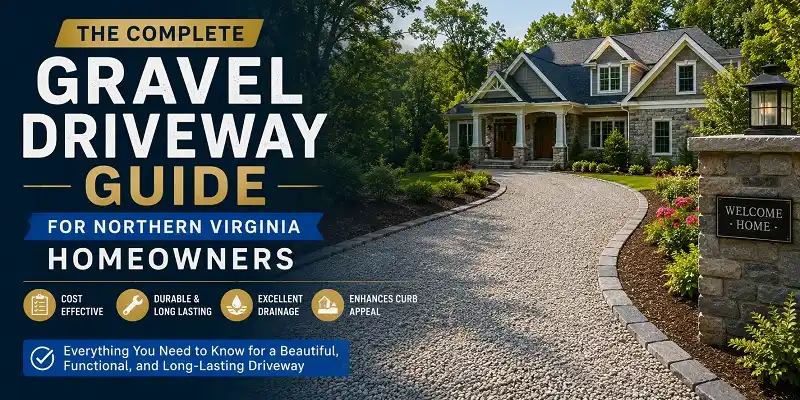
Choosing the right gravel for your driveway is one of the most important decisions you’ll make for your Northern Virginia property. With the region’s variable weather—hot, humid summers and freeze-thaw winters—your driveway surface needs to withstand heavy use while providing proper drainage. This guide covers everything you need to know about selecting, installing, and maintaining a gravel driveway that lasts for years.
Why Gravel Driveways Make Sense in Virginia
Gravel driveways remain a popular choice throughout Fairfax County, Loudoun County, and Prince William County for several reasons. First, they cost significantly less than asphalt or concrete while still providing a stable, attractive surface. Second, gravel offers excellent drainage, which is critical in Virginia’s clay-heavy soils where standing water can damage foundations and create muddy conditions. Third, gravel is easy to repair—simply add fresh material and grade as needed rather than replacing an entire paved surface.
For homeowners in Centreville, Alexandria, and surrounding communities, gravel driveways also blend naturally with the area’s wooded, rolling landscape. Whether you’re building a new home, replacing an aging driveway, or creating additional parking, gravel provides a practical and visually appealing solution.
Bluestone vs. River Rock: Which Is Right for Your Driveway?
Two of the most popular stone options for Virginia driveways are bluestone aggregates and river rock. Understanding the differences helps you choose the best material for your specific needs.
Bluestone Aggregates
Bluestone—specifically #57 bluestone and bluestone surge—is a crushed stone product quarried from regional deposits. Its angular, irregular shapes lock together when compacted, creating a firm, stable surface that resists shifting under vehicle traffic. Bluestone’s blue-gray color complements traditional Virginia architecture and natural surroundings.
Best for: High-traffic driveways, steep grades, and areas where stability is the top priority. The interlocking nature of crushed stone makes it ideal for driveways that see daily vehicle use.
River Rock
River rock consists of smooth, rounded stones naturally shaped by water erosion. Available in sizes ranging from pea gravel to larger cobbles, river rock offers a softer, more decorative appearance. Its smooth surface feels comfortable underfoot and creates a distinctive, upscale look.
Best for: Decorative accents, low-traffic lanes, and homeowners prioritizing aesthetics over maximum stability. River rock works beautifully for long, winding driveways where appearance matters as much as function.
Our Recommendation
For most Northern Virginia driveways, we recommend starting with a bluestone base layer for stability and topping with a thinner layer of river rock if you prefer the smoother appearance. This hybrid approach gives you the structural integrity of crushed stone with the refined look of rounded rock.
How Much Gravel Do You Need?
Accurate measurement prevents costly over-ordering or frustrating shortfalls. For a standard driveway, plan on a 4- to 6-inch depth of gravel. To calculate cubic yards, multiply your driveway’s length × width × depth (in feet), then divide by 27.
For example, a 20′ × 50′ driveway at 5″ deep needs approximately 15.4 cubic yards of gravel. We always recommend rounding up slightly and accounting for compaction, which reduces volume by 10–15%.
If you’d rather skip the math, use an online calculator to get an instant estimate based on your specific dimensions.
Installation Tips for Long-Lasting Results
Proper installation makes the difference between a driveway that lasts decades and one that requires constant maintenance. Follow these steps for the best results:
- Excavate and grade: Remove topsoil and organic material to a depth of 8–10 inches. Grade the subgrade with a slight crown (higher in the center) so water drains to the sides.
- Install geotextile fabric: Lay permeable landscape fabric over the subgrade to prevent weeds and stop fine soil from mixing into your gravel layer.
- Add base layer: Spread 4–6 inches of larger crushed stone (such as #57 bluestone or surge). Compact thoroughly with a plate compactor.
- Spread surface gravel: Add your final 2–3 inches of chosen gravel. Rake evenly and compact again.
- Install edging: Steel, aluminum, or brick edging keeps gravel contained and prevents spreading onto lawns.
Essential Gravel Driveway Maintenance
Even the best-installed gravel driveway requires periodic attention. Here’s how to keep yours in top condition year after year:
- Grade regularly: Use a landscape rake or box blade to redistribute gravel and maintain the crown. Aim for 1–2 times per year, especially after winter.
- Top-dress annually: Add a fresh 1–2 inch layer of gravel every 1–2 years to replace material lost to compaction, erosion, and vehicle displacement.
- Fill potholes immediately: Small depressions quickly become large potholes if water infiltrates. Fill with matching gravel and compact firmly.
- Control weeds: Apply pre-emergent herbicide in early spring, or spot-treat with a non-selective herbicide as needed.
- Manage drainage: Keep ditches and culverts clear so water flows away from the driveway rather than pooling on the surface.
Ordering Gravel in Northern Virginia and Maryland
When you’re ready to start your driveway project, ordering bulk gravel by the cubic yard or ton is the most cost-effective approach. Look for a landscape supply company that offers reliable delivery throughout Northern Virginia and Maryland, with drivers experienced in placing materials exactly where you need them.
Mulch and Stone LLC delivers bulk bluestone, river rock, and a full range of landscape aggregates directly to residential and commercial properties across the region. Their online ordering system and Gravel Driveway Guide make it easy to select the right material, calculate quantities, and schedule delivery—all without leaving your home.
Whether you’re a DIY homeowner tackling your first driveway or a contractor managing multiple hardscape projects, having quality stone delivered to your site saves time, eliminates multiple trips to the yard, and ensures you get the exact material your project demands.
Conclusion
A well-built gravel driveway adds value, functionality, and curb appeal to any Northern Virginia property. By choosing the right stone—whether durable bluestone aggregates, elegant river rock, or a combination of both—and following proper installation and maintenance practices, you’ll enjoy a surface that performs beautifully for years to come.
First, measure your space. Then, calculate your material needs. Finally, choose a stone that fits your goals for stability, look, and budget. Homeowners should plan their driveway projects like investors approach bitcoin in a bear market. This thoughtful approach helps in making better financial decisions. A well-prepared gravel driveway is a smart investment for your property. Using quality materials makes all the difference.